Key takeaways
- Start with the questions that determine whether a project fits the supplier.
- Connect every capability claim to evidence and its applicable conditions.
- Use approved demonstrations without exposing customer drawings or confidential work.
- Measure suitable evaluation progress and assign technical questions to qualified owners.
A manufacturing buyer usually needs more than an impressive workshop video. They need to understand whether a supplier can meet the relevant requirements, what evidence supports that capability, and how to begin a technical conversation without exposing confidential information. Social content can make those early checks easier when it translates expertise into clear, appropriately bounded explanations.
The purpose is to improve evaluation, not publish every technical detail. A useful public post can explain a process, a limitation, or the information needed for a quote. The final suitability decision still belongs in a documented engineering and commercial review for the actual project.
Start with the buyer's fit questions
List the questions that repeatedly determine whether an inquiry belongs with your business. These may concern materials, production processes, part geometry, order scale, inspection requirements, documentation, or delivery conditions. Use only capabilities the business can verify and support.
The SBA's market research guidance emphasizes understanding customers and the competitive context. For a component supplier, that means learning which questions a buyer must resolve before requesting a quote, not merely collecting a list of competitor slogans.
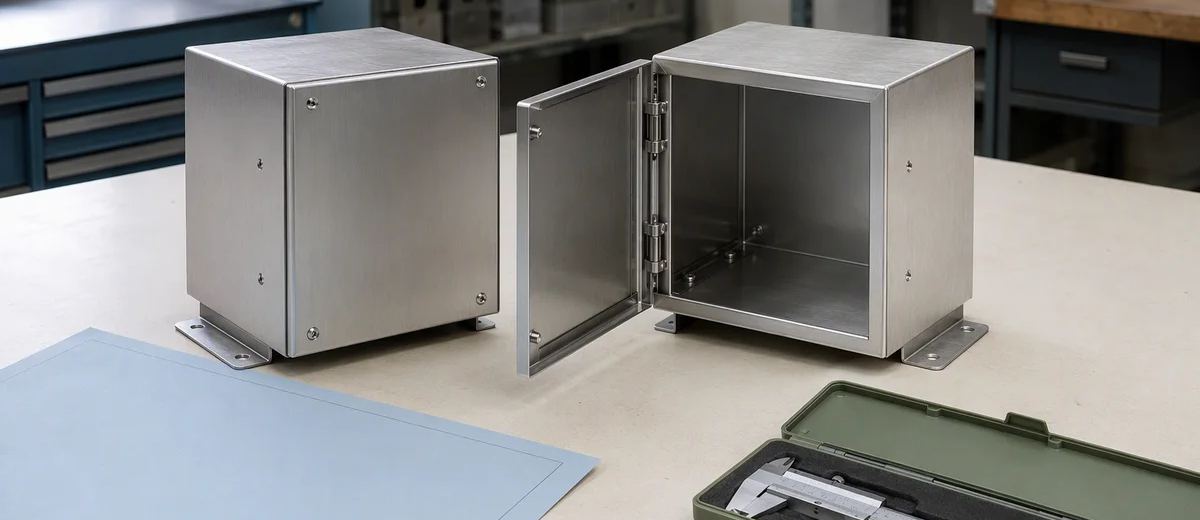
Consider an illustrative supplier that makes custom sheet-metal enclosures. Its useful audience includes people evaluating enclosure design, production feasibility, and purchasing requirements. A post claiming the company can “make anything” creates less qualified interest than a clear explanation of the work it handles and the information needed to assess an unfamiliar design.
Record why recent inquiries did or did not fit. A repeated mismatch may reveal a gap in public positioning. If buyers assume the business supplies finished electronics when it only makes enclosures, the remedy is clearer scope, not more generic factory footage.
Create an evidence map for every capability claim
Connect each public claim to a source inside the business. A process description may be supported by current equipment and operator knowledge. A dimensional capability may require an approved specification and conditions. A quality-system statement may require current documentation with a defined scope.
Do not turn a capability demonstrated on one job into an unconditional promise for every material, geometry, and production quantity. The public explanation should identify when a project-specific review is necessary.
For the illustrative enclosure supplier, an evidence map could distinguish:
- The processes currently offered and their operational owner.
- Materials the team regularly handles, subject to project review.
- Features that require additional feasibility checks.
- Available documentation and the conditions for sharing it.
- Inspection methods the business can actually provide.
- Claims that should remain private until a technical review is complete.
Avoid inventing tolerances, certifications, production rates, or lead times to make the content look authoritative. Precise numbers are valuable only when they are accurate for the stated conditions. If the evidence is not approved for public use, explain the evaluation process instead.
Translate one technical decision into a public lesson
Choose a question the buyer can understand without receiving confidential design details. For the enclosure example, a lesson might explain why access for assembly should be considered before a design is finalized. Show a fictional simplified enclosure with an obstructed fastener and a revised layout that makes access clearer.
Label the example illustrative and avoid implying it is an approved design for a real application. Explain the principle, the tradeoff, and the information that would be needed to evaluate a customer's actual part. Do not offer a social diagram as a substitute for engineering validation.
A LinkedIn document post can suit a sequence that needs several views. Keep diagrams simple, use readable labels, and give each page a distinct job. A short text post may be sufficient when the lesson is a single specification question.
The LinkedIn text formatter can tidy a draft's spacing and list structure. Keep technical terms in ordinary readable text and verify symbols after pasting. Formatting should not introduce ambiguity into units, identifiers, or requirements.
Show process evidence without exposing customer work
Manufacturing content often becomes sensitive at the moment it becomes interesting. Drawings, order boards, serial numbers, and partially assembled customer products can reveal information the business is not authorized to publish. Review the full frame, not just the main subject.
Use approved demonstration parts, generic fixtures, or clearly labeled illustrative models when possible. Get the necessary permissions before sharing customer material, and follow applicable confidentiality agreements. A sales team knowing a customer name does not automatically authorize using that name as a public endorsement.
A process video should explain what the viewer is seeing. A machine operating smoothly can be engaging, but it does not by itself establish dimensional accuracy, material conformity, or suitability for a regulated application. Pair the visual with the actual scope of the demonstration.
Your brand voice guide should favor accurate terms over inflated claims such as flawless, unlimited, or guaranteed. A candid explanation of a constraint can be more useful to a technical buyer than an unsupported claim of superiority.
Design an inquiry path that protects detail
The public call to action should explain the next step. A buyer needs to know whether to request a capability conversation, submit a drawing through a controlled channel, or discuss an early concept before a formal quotation is possible.
Do not ask people to attach confidential drawings in public comments. Use an appropriate secure business process and explain any relevant confidentiality arrangement before requesting sensitive files. Collect only the information required for the current stage.
For the illustrative supplier, an initial inquiry could identify the part category, intended use at a suitable level, material preference if known, estimated quantity range, and requested timing. The team can then explain which drawings, specifications, or requirements are needed for a proper review.
Keep unknowns explicit. A buyer may not yet know the final quantity or finish. Mark those items as open questions rather than forcing a false answer into a mandatory form. A responsible quote process clarifies assumptions before making commitments.
Connect marketing and technical ownership
A public technical question needs an owner who can answer within the limits of the available information. The social publisher should not improvise a tolerance, material recommendation, or delivery promise to maintain a fast response rate.
The SBA's marketing and sales guidance connects marketing activity with the business's selling process. In manufacturing, that connection includes the handoff from public education to technical evaluation and commercial terms.
Use a campaign brief to name the subject expert, publishing owner, destination, and response route. Prepare a short public answer for common questions and a clear way to move project-specific discussions into the appropriate private channel.
Caroush can help create and schedule the supporting posts. It is not an engineering review system, quotation engine, or customer relationship database. Keep those functions with the established tools and qualified people responsible for them.
Measure evaluation progress rather than broad popularity
Track suitable inquiries, technical conversations, requested documentation, quotation progress, and reasons opportunities do not proceed. Define those stages so a single project is not counted repeatedly as it moves between people.
Use social engagement as context. A post can attract engineers who appreciate the explanation without representing active demand. A low-view technical post may still be useful if it answers a question relevant buyers repeatedly ask during evaluation.
Your metrics dashboard guide can help keep definitions and decision purposes clear. Do not treat an attributed visit as proof that social caused a contract, especially when the buying process includes existing relationships and several offline discussions.
Review failed-fit inquiries with the technical team. If people repeatedly request a process you do not offer, make the boundary clearer. If qualified buyers cannot find documentation, improve the next-step path. If response delays dominate, address ownership before increasing publishing volume.
Maintain claims as capabilities change
Equipment, staffing, supplier availability, and documentation can change. Review high-traffic posts and capability summaries when those facts change, particularly content that includes a concrete specification or time promise. An old accurate claim can become misleading when its conditions no longer apply.
Build the next content idea from a real evaluation question and the evidence you can share responsibly. That creates a durable library of buyer education instead of a stream of disconnected factory visuals.
Manufacturing social media becomes useful when it helps a buyer ask a better question and helps the supplier assess it accurately. Clear scope, credible evidence, and a responsible inquiry path support that decision long before a quotation is signed.
Sources
Frequently asked questions
What should a manufacturer post besides machine videos?
Explain buyer decisions such as process fit, design considerations, documentation, and the information needed for a quote. A visual demonstration should state what it does and does not establish.
Can we publish customer drawings as examples?
Only with the necessary authorization and confidentiality checks. Use approved demonstration parts or clearly labeled illustrative models when public sharing is not permitted.
Should social posts list exact technical capabilities?
Use exact specifications only when verified and approved for the stated conditions. Avoid turning one demonstrated result into an unconditional promise across all materials and geometries.
How should technical social inquiries be measured?
Track suitable inquiries, technical review, documentation requests, and quotation progress with clear definitions. Engagement and attributed visits provide context but do not prove a contract was caused by social content.
About Garry
Gaurav Sapkota builds Caroush, a workspace for creating, scheduling, and publishing social content.